Rate this post

193 Exam Questions for AZ-220 Updated Versions With Test Engine

Pass AZ-220 Exam with Updated AZ-220 Exam Dumps PDF 2023

NEW QUESTION 65
Note: This question is part of a series of questions that present the same scenario. Each question in the series contains a unique solution that might meet the stated goals. Some question sets might have more than one correct solution, while others might not have a correct solution.
After you answer a question in this section, you will NOT be able to return to it. As a result, these questions will not appear in the review screen.
You have a Standard tier Azure IoT hub and a fleet of IoT devices.
The devices connect to the IoT hub by using either Message Queuing Telemetry Transport (MQTT) or Advanced Message Queuing Protocol (AMQP).
You need to send data to the IoT devices and each device must respond. Each device will require three minutes to process the data and respond.
Solution: You use direct methods and check the response.
Does this meet the goal?


NEW QUESTION 66
You have an Azure subscription that contains an Azure IoT hub and two IoT devices named Device1 and Device2.
You plan to deploy an Azure IoT Edge gateway device named Gateway1.
You need to ensure that all device-to-cloud messages and twin change notifications from Device1 and Device2 to the IoT hub are routed by using Gateway1.
What tasks should you perform to configure the devices? To answer, select the appropriate options in the answer area.
NOTE: Each correct selection is worth one point.

NEW QUESTION 67
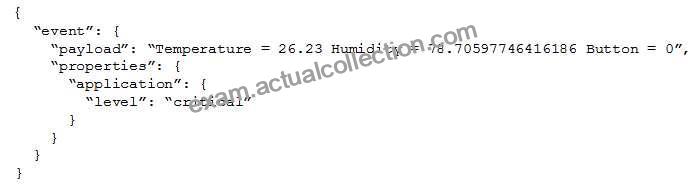
What should you do to identify the cause of the connectivity issues?


NEW QUESTION 68
Note: This question is part of a series of questions that present the same scenario. Each question in the series contains a unique solution that might meet the stated goals. Some question sets might have more than one correct solution, while others might not have a correct solution.
After you answer a question in this section, you will NOT be able to return to it. As a result, these questions will not appear in the review screen.
You have an Azure IoT solution that includes an Azure IoT hub, a Device Provisioning Service instance, and
1,000 connected IoT devices.
All the IoT devices are provisioned automatically by using one enrollment group.
You need to temporarily disable the IoT devices from connecting to the IoT hub.
Solution: You disconnect the Device Provisioning Service from the IoT hub.
Does this meet the goal?


NEW QUESTION 69
You are building an Azure loT solution that will include an Azure loT hub and will process environmental data for a multi-story building by using Azure Stream Analytics. The loT devices for the solution will provide the following data:
* Temperature
* Building
* Room
* Floor
You need to identify which data formats the loT devices can use to send the data as an array. What should you identify?


NEW QUESTION 70
You have an Azure IoT hub that has 1,000 registered devices.
You create an Azure logic app.
You need to send Device Connected and Device Disconnected events in real time to the logic app.
What should you do?


NEW QUESTION 71
You have an Azure IoT Central application.
You need to connect IoT devices that use SAS tokens to the application without first registering the devices.
In which order should you perform the actions? To answer, move all actions from the list of actions to the answer area and arrange them in the correct order.

NEW QUESTION 72
You have an Azure IoT solution that includes a standard tier Azure IoT hub and an IoT device.
The device sends one 100-KB device-to-cloud message every hour.
You need to calculate the total daily message consumption of the device. What is the total daily message consumption of the device?


NEW QUESTION 73
You have an Azure IoT solution that includes several Azure IoT hubs.
A new alerting feature was recently added to the IoT devices. The feature uses a new device twin reported property named alertCondition.
You need to send alerts to an Azure Service Bus queue named MessageAlerts. The alerts must include alertConditionand the name of the IoT hub.
Which two actions should you perform? Each correct answer presents part of the solution.
NOTE: Each correct selection is worth one point.


NEW QUESTION 74
You have 1,000 devices that connect to an Azure IoT hub.
You are performing a scheduled check of deployed IoT devices.
You plan to run the following command from the Azure CLI prompt.
az iot hub query –hub-name hub1 –query-command “SELECT * FROM devices WHERE connectionState = ‘Disconnected'” What does the command return?


NEW QUESTION 75
You have an Azure loT solution that contains an Azure IoT hub and the Azure IoT Edge gateways shown in the following table.

You have the leaf devices shown in the following table.

The IoT hub receives the messages shown in the following table.

You plan to a deploy a new Azure Time Series Insight environment.
You need to recommend a Time Series ID property name to ensure that the telemetry of each device will be stored in a separate time series instance.
What should you recommend?


NEW QUESTION 76
You have three Azure IoT hubs named Hub1, Hub2, and Hub3, a Device Provisioning Service instance, and an IoT device named Device1.
Each IoT hub is deployed to a separate Azure region.
Device enrollment uses the Lowest latency allocation policy.
The Device Provisioning Service uses the Lowest latency allocation policy.
Device1 is auto-provisioned to Hub1 by using the Device Provisioning Service.
Device1 regularly moves between regions.
You need to ensure that Device1 always connects to the IoT hub that has the lowest latency.
What should you do?


NEW QUESTION 77
You have 1,000 devices that connect to an Azure IoT hub.
You discover that some of the devices fail to send data to the IoT hub.
You need to ensure that you can use Azure Monitor to troubleshoot the device connectivity issues.
Which two actions should you perform? Each correct answer presents part of the solution.
NOTE: Each correct selection is worth one point.


NEW QUESTION 78
You have an Azure IoT Central application that includes a Device Provisioning Service instance.
You need to connect IoT devices to the application without first registering the devices.
In which order should you perform the actions? To answer, move all actions from the list of actions to the answer area and arrange them in the correct order.

NEW QUESTION 79
You have an Azure IoT hub and three Azure IoT Edge devices. The device twin code for each device is shown in the following table.

A standard automatic deployment is already applied.
You have three layered deployments. The deployment code for each deployment is shown in the following table.

For each of the following statements, select Yes if the statement is true. Otherwise select No. NOTE: Each correct selection is worth one point.

NEW QUESTION 80
You have the devices shown in the following table.

You are implementing a proof of concept (POC) for an Azure IoT solution.
You need to deploy an Azure IoT Edge device as part of the POC.
On which two devices can you deploy IOT Edge? Each correct answer presents a complete solution.
NOTE: Each correct selection is worth one point.


NEW QUESTION 81
You have an Azure IoT Central application that includes a Device Provisioning Service instance.
You need to connect IoT devices to the application without first registering the devices.
In which order should you perform the actions? To answer, move all actions from the list of actions to the answer area and arrange them in the correct order.

NEW QUESTION 82
You have an Azure IoT hub.
You plan to deploy 1,000 IoT devices by using automatic device management.
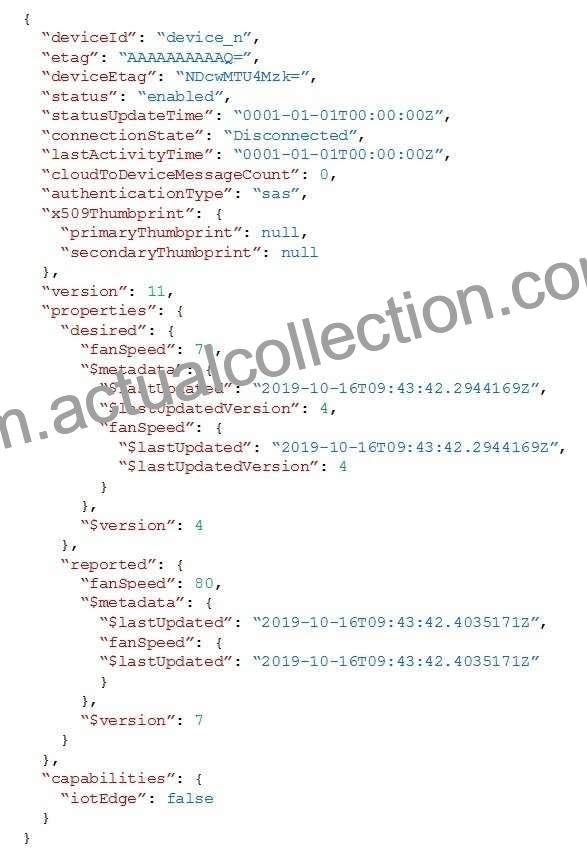
The device twin is shown below.
You need to configure automatic device management for the deployment.
Which target Condition and Device Twin Path should you use? To answer, select the appropriate options in the answer area.
NOTE: Each correct selection is worth one point.

NEW QUESTION 83
DRAG DROP
You need to install the Azure IoT Edge runtime on a new device that runs Windows 10 IoT Enterprise.
Which four actions should you perform in sequence? To answer, move the appropriate actions from the list of actions to the answer area and arrange them in the correct order.
Select and Place:

NEW QUESTION 84
You have an Azure IoT hub that uses a Device Provision Service instance.
You plan to deploy 100 IoT devices.
You need to confirm the identity of the devices by using the Device Provision Service.
Which three device attestation mechanisms can you use? Each correct answer presents a complete solution.
NOTE: Each correct selection is worth one point.


NEW QUESTION 85
You have an Azure IoT solution that includes an Azure IoT hub.
You receive a root certification authority (CA) certificate from the security department at your company.
You need to configure the IoT hub to use the root CA certificate.
Which four actions should you perform in sequence? To answer, move the appropriate actions from the list of actions to the answer area and arrange them in the correct order.

NEW QUESTION 86
You deploy an Azure IoT hub.
You need to demonstrate that the IoT hub can receive messages from a device.
Which three actions should you perform in sequence? To answer, move the appropriate actions from the list of actions to the answer area and arrange them in the correct order.

NEW QUESTION 87
You develop a custom Azure IoT Edge module named temperature-module.
You publish temperature-module to a private container registry named mycr.azurecr.io You need to build a deployment manifest for the IoT Edge device that will run temperature-module.
Which three container images should you define in the manifest? Each correct answer presents part of the solution.
NOTE: Each correct selection is worth one point.


NEW QUESTION 88
You have the following device twin for the IoT device.

For each of the following statements, select Yes if the statement is true. Otherwise, select No.
NOTE: Each correct selection is worth one point.

NEW QUESTION 89
You have an Azure IoT hub named Hub1 and a root certification authority (CA) named CA1. Hub1 is configured to use X.509 certificate device authentication.
You and a custom manufacturing partner complete a proof of possession flow.
You plan to deploy IoT devices manufactured by the custom manufacturing partner. Each device will have a certificate generated by an intermediate CA. The devices will authenticate by using device certificates signed by the partner.
You need to ensure that the custom devices can connect successfully to Hub1.
Which three actions should you perform in sequence? To answer, move the appropriate actions from the list of actions to the answer area and arrange them in the correct order.


AZ-220 Exam Dumps – Free Demo & 365 Day Updates: https://www.actualcollection.com/AZ-220-exam-questions.html

Related Links: myportal.utt.edu.tt www.stes.tyc.edu.tw www.stes.tyc.edu.tw myportal.utt.edu.tt myportal.utt.edu.tt myportal.utt.edu.tt